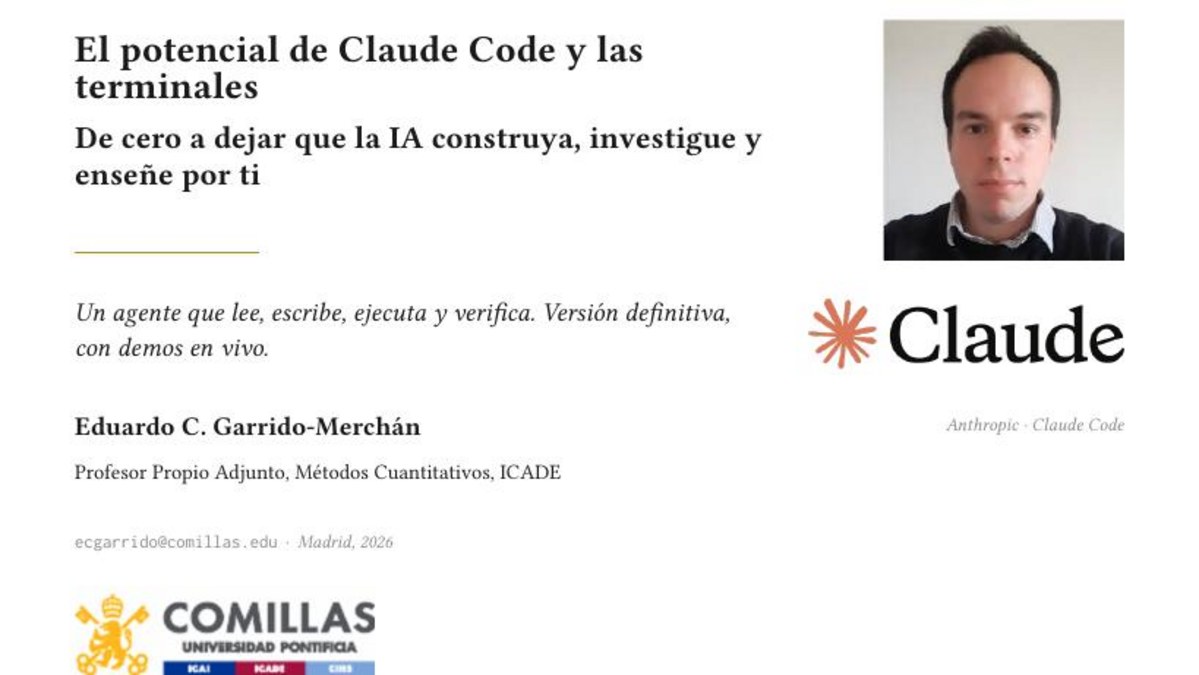
Hands-on seminar · 2026 · delivered in Spanish
El potencial de Claude Code y las terminales
Abstract
Claude Code turns the terminal into an agent you talk to in plain language: a model with hands that reads, writes, runs and verifies code and documents on your own files. This one-hour seminar, delivered in Spanish with live demos, shows how far that goes for university teaching and research, and where the human stays in control.
We move from foundations (chatbot versus agent, the new Claude family, permissions) to building (a reproducible paper figure, a numerical method verified against its closed-form solution), to research (automatic literature synthesis, a dense paper turned into a study dossier, a reproducible scientific analysis, and a zero-hallucination bibliography-verification loop), to orchestration (three adversarial referees reviewing a manuscript, a pipeline that drafts a paper end to end, a whole course parallelised one agent per topic).
The final blocks cover connection (MCP, Slack, Gmail, hooks, headless CI), the teaching toolkit (exercises and exams with rubric and version B, lecture notes, interactive HTML slides, design artifacts), how to keep control, and a closing on sovereignty: if frontier AI moves to per-use pricing or data cannot leave the organisation, the same agentic architecture can run fully local — illustrated with Florentino, the local agentic system built by the CI2LAB (Cátedra de Industria Inteligente, Comillas ICAI).
The seminar is built around live, improvised demos. The demo pack (ZIP above) bundles the prompt and setup for each, ready to run with claude.
Orchestrate
From one command to a full paper
A single /bo order chains a dozen specialised sub-agents: idea, verified literature, theory, tested implementation, experiments, writing and adversarial review.
Orchestrate
Three adversarial referees read your manuscript
Canonical-order reviewer, experiments-first reviewer and a reference verifier read the same .tex in parallel and consolidate one report by severity.
Research
Zero-hallucination bibliography
A mechanical validator compares every BibTeX field against the downloaded source, and independent verifier agents repeat the audit until it is clean.
Teaching
Exercises and exams with rubric, solution and version B
From the syllabus, /examenes produces a full exam with rubric, worked solutions and a parallel, equal-difficulty version B.
Teaching
Lecture notes from a syllabus and its sources
/apuntes weaves a syllabus and several sources into coherent notes: continuous prose, boxed definitions, worked examples and its own figures.
Teaching
Interactive HTML slides
The interactive-slides skill turns a topic into a self-contained HTML deck where every parameter is manipulable live on a canvas.
Connect
Slack: the agent where your team already works
Through the Slack connector, Claude reads a channel, synthesises the main threads and drafts a summary — the same agent, on the surface your team lives in.
Connect
Gmail triage with a human in the loop
Through the Gmail connector, Claude labels what is urgent and prepares reply drafts; it never sends or deletes — you review and hit send.
Closing · Sovereignty: Florentino (CI2LAB)
The talk ends with a local-first alternative for governance and cost control: Florentino, a local multi-model agent over Ollama (open 7B–32B models) that keeps the same agentic loop and sub-agents while no byte leaves your machine. Built by the CI2LAB — Cátedra de Industria Inteligente, Universidad Pontificia Comillas ICAI (J. Alonso, T. Contreras, C. Lucena, A. Rodríguez, P. Sánchez).